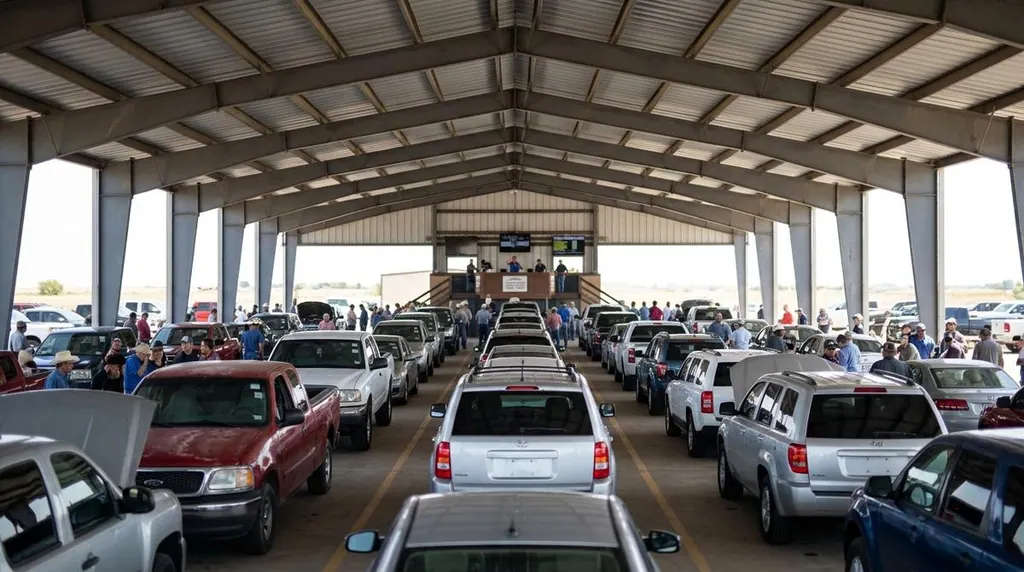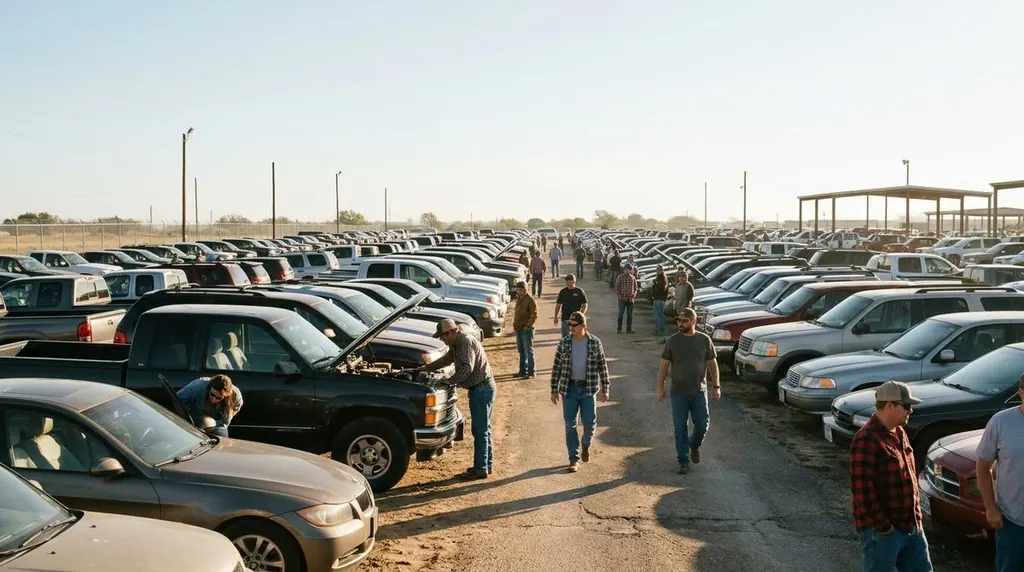
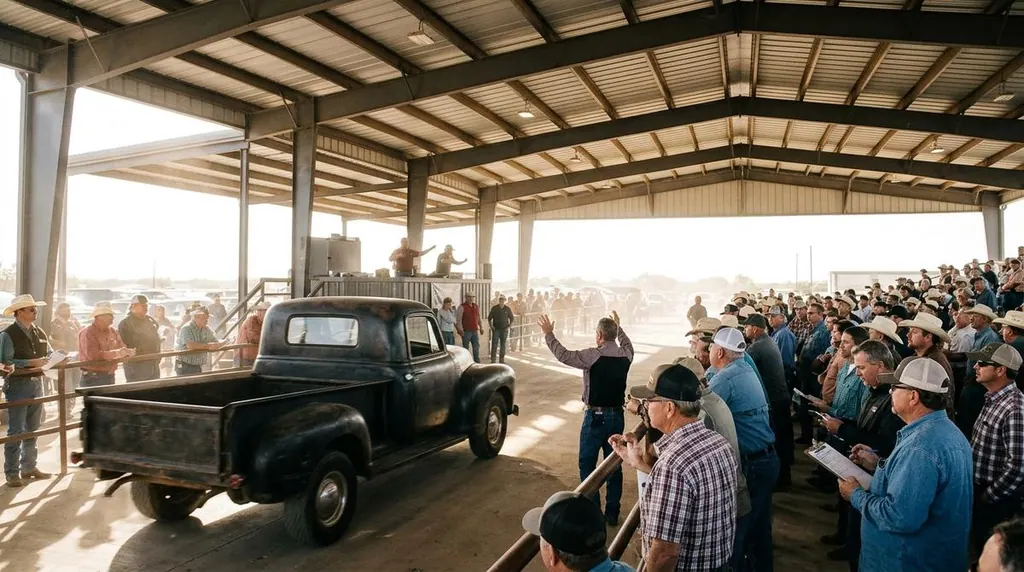
Here is how car auctions work in Texas. They fall into four groups: wholesale dealer auctions, salvage and insurance auctions, public consumer auctions, and government or police auctions. Only the last two, plus some lots at salvage auctions, are open to an ordinary buyer. Every auction car is sold as-is, so the title check, the inspection and the total cost are your job before you bid.
This guide explains how each type works between Austin and San Antonio, what the law says about buying and reselling, and where the real risks are. For a list of specific auctions in the corridor, see the auctions hub.
The four types of car auctions
| Type | Who can bid | Typical cars | Examples near the corridor |
|---|---|---|---|
| Wholesale (dealer-only) | Licensed dealers | Trade-ins, off-lease, fleet, dealer consignment | Manheim San Antonio, ADESA San Antonio, OPENLANE (online) |
| Salvage and insurance | Licensed buyers; public buyers only on lots marked for them | Insurance total losses, theft recoveries, some clean-title cars | Copart, IAA Austin, IAA San Antonio-South |
| Public consumer auctions | Anyone who registers | Used retail, consignment, fleet, donations | Metro Auto Auction (Dale), Public Auto Auctions (Kyle) |
| Government and police | Anyone who registers | Retired fleet cars, unclaimed impounds | City of Austin fleet surplus, SAPD impound auctions, state surplus |
Wholesale dealer auctions
Manheim and ADESA/OPENLANE are wholesale marketplaces. OPENLANE says it is built for licensed automotive dealers, and Manheim routes new buyer enrollments through AuctionACCESS, a dealer credentialing system (Manheim registration page). Manheim San Antonio is at 2042 Ackerman Rd and sells on Wednesdays, according to Manheim's Texas locations page. ADESA San Antonio is at 200 S. Callaghan Road and runs Thursday sales for registered dealers.
A consumer without a dealer license cannot buy at these auctions directly. More on that in dealer-only vs public car auctions.
Salvage and insurance auctions
Copart and IAA sell cars that insurers have paid out as total losses, plus theft recoveries and some clean-title vehicles. They admit some public buyers, but the rules depend on the state and on each vehicle. IAA says a Public Buyer account sees only inventory available to the public, and a branch being open to the public does not mean every vehicle is. Copart marks some lots "No License Required", meaning the laws of the state where the car sits let the general public buy it.
Most cars here carry a salvage or nonrepairable brand. Read salvage auctions: Copart and IAA risks before you register.
Public consumer auctions
A few auctions in the corridor sell directly to the public. Metro Auto Auction in Dale labels its sales a public online auction with weekday previews. Public Auto Auctions in Kyle runs a weekly internet auction that it says is open to dealers, repair shops and the general public, with items sold as-is and no warranty. Sale dates change, so check each site for the current schedule.
Government and police auctions
Cities, counties and the state sell retired fleet vehicles, and police departments sell unclaimed impounds. The City of Austin Fleet Mobility Services page sends buyers to GovDeals and Gaston & Sheehan. The San Antonio Police Department holds periodic in-person auctions at the City Vehicle Impound Facility, 3625 Growdon Road.
Local notes: auctions around Austin and San Antonio
The corridor has more auction lanes than most buyers expect, but only some of them are open to you. This is how they split, based on each operator's own site and the auctions hub.
Austin side. Metro Auto Auction at 2221 Hwy 21 W in Dale runs periodic Saturday online public auctions and lists weekday preview hours. Public Auto Auctions at 12253 Camino Real in Kyle runs a weekly internet auction and allows proxy bids before the live sale. IAA Austin, at 2191 Highway 21 West in Dale, says on its branch page that it is open to public buyers, but only on lots offered to the public. America's Auto Auction Austin in Buda describes itself as a wholesale auction with dealers in-lane, and Alliance Auto Auction in Hutto serves registered wholesale dealers.
San Antonio side. Manheim San Antonio and ADESA San Antonio are dealer lanes. IAA San Antonio-South at 11275 S. Zarzamora St. is open to public buyers on public lots. The SAPD impound auctions are announced in SAPD news releases and on the SAPD Facebook page, require payment on sale day by cash or credit card (no American Express), and require removal by 4 p.m. on the Friday of auction week.
Where you live changes the paperwork. You title and register the car in your own county. Travis and Williamson counties require an emissions test before registration, and Bexar County joined the list on November 1, 2026. Hays, Comal, Guadalupe and Caldwell counties are not on the state emissions list (TCEQ). Texas also dropped the safety inspection for non-commercial vehicles on January 1, 2025 (Texas DPS), so no state inspector will look at an auction car before it goes back on the road. Your own mechanic is the only check.
How car auctions work in Texas, step by step
Most auctions follow the same pattern, live or online.
- Register. Create a buyer account with government photo ID. Dealer auctions also need dealer credentials. Some sites ask for a deposit or card on file.
- Preview. Inspect the car during preview hours, or read the online listing, photos and any condition report.
- Research the VIN. Run a title history and recall check before bidding (details below).
- Bid. Bid live in the lane, by proxy (a maximum bid placed ahead of time), or online. A winning bid is a binding contract.
- Pay. Pay the hammer price plus any buyer fee, by the deadline and in the payment form the auction accepts.
- Collect title and car. Remove the car by the pickup deadline or storage charges may start. Salvage cars cannot be driven away on public roads.
- Title and register. Title the car in your name at the county tax assessor-collector office.
Fees: plan for more than the winning bid
The hammer price is not the total. Auctions add buyer fees, and some add online bidding, late payment, title or storage fees. Manheim's public terms say these fees follow each location's current fee schedule, so no single fee table applies everywhere. Public Auto Auctions says taxes, title, license and other fees are calculated after the sale. Ask each auction for its written fee schedule before you register, and do not rely on fee amounts posted by third-party sites.
After the auction, Texas costs also apply:
- Sales tax. Texas motor vehicle sales tax is 6.25 percent of the sales price. When a private party or non-dealer sells, the buyer pays it to the county when titling. Confirm with the county tax office how your auction sale is treated.
- Title fee. The title application fee is $33 in every corridor county (Travis, Williamson, Hays, Caldwell, Bastrop, Comal, Guadalupe, Bexar and Wilson), per the TxDMV Motor Vehicle Title Manual.
- Emissions. Travis and Williamson counties require an emissions test before registration, and Bexar County joins on November 1, 2026, per TCEQ.
Title rules that matter at auctions
Texas uses three key title conditions. A salvage vehicle is one whose repair cost (excluding repainting and sales tax) exceeds its actual cash value before the damage. It can be repaired and retitled as rebuilt after the required paperwork. A nonrepairable vehicle is only good for parts or scrap. Titles can also carry a flood damage remark (Transportation Code Chapter 501).
TxDMV says a vehicle with a salvage brand must be rebuilt and inspected before it can return to the road (TxDMV salvage brands). A 2003-or-later Texas nonrepairable vehicle may never be rebuilt, retitled with a regular title, registered or driven in Texas (TxDMV Salvage/Nonrepairable Manual). See rebuilt and salvage titles in Texas.
Before bidding, run the VIN through TxDMV Title Check, which uses NMVTIS, the national title database. Also check open recalls at NHTSA.gov/recalls.
The license question: buying for yourself vs buying for others
Buying a car at a public auction for your own use is open to anyone who meets the auction's rules. Buying cars to resell, or arranging purchases for other people, is different.
Texas Transportation Code 503.021 says a person may not engage in business as a dealer, "directly or indirectly, including by consignment," without a dealer general distinguishing number (GDN) (Chapter 503). Section 503.024 exempts people who sell fewer than five vehicles of the same type in a calendar year that are owned and registered in their own name. Arranging auction purchases for other people for a fee, or flipping cars that are not titled to you, is dealer activity under that statute, and doing it without a GDN is unlicensed dealing. Salvage purchases have their own limits: TxDMV's manual says a person who buys or rebuilds more than five salvage or nonrepairable vehicles in a calendar year must hold a salvage or independent dealer license.
If someone offers to "get you into" a dealer auction for a fee, treat it as a warning sign. See curbstoning in Texas.
Common mistakes first-time auction buyers make
- Bidding on the photo, not the car. Listing photos are taken to sell. If the auction has a preview, go. If it does not, bid as if the car needs repairs you cannot see.
- Skipping the VIN check because the auction "already checked it." Run the title and recall checks yourself before you register for the sale.
- Forgetting the fees and tax. The hammer price plus buyer fee, sales tax, title fee and transport is your real cost. Write the total down before the bidding starts.
- Assuming a public branch means a public car. At IAA, a branch open to the public can still list lots that need a licensed account.
- Not planning pickup. Auctions set removal deadlines, and storage charges can start after them. Line up a trailer or tow before you bid, not after you win.
- Bidding on a nonrepairable car to fix and drive. A 2003-or-later Texas nonrepairable vehicle can never be registered here. Read the title type twice.
- Paying someone to bid for you. A person without a dealer license who arranges car purchases for others for a fee is acting as a dealer under Texas law. That route puts your money and your title at risk.
What I would do before my first Texas car auction
If I were going to my first public auction between Austin and San Antonio, I would treat it as a research trip first. I would register, go to a preview, watch one full sale without bidding, and write down what similar cars sold for. That costs a Saturday, and it shows you how fast the bidding moves and how the fees work at that specific auction.
When I was ready to bid, I would pick two or three cars, not one, so I never feel I have to win a specific car. For each one I would run TxDMV Title Check and the NHTSA recall lookup, read the model's NHTSA complaint history, and set a walk-away number that already includes fees, tax, title and transport. Then I would stop at that number, even if the car goes for one bid more.
I would also skip salvage lots on a first purchase. Rebuilding a salvage car means parts, labor, inspections and paperwork, and the rebuilt brand stays on the title. That is a project, not a commute car.
Main risks to weigh
- As-is, final sale. Government surplus, as TxDOT's surplus page states, is sold as-is with no warranty and sales are final. Most public auctions work the same way.
- Little or no test drive. You may only be able to start the car, or see photos.
- Hidden damage. Flood and frame damage can be hard to see.
- Transport. Salvage cars and cars without registration need a trailer or tow.
- Bidding fever. Set a maximum that includes fees, tax, transport and repairs, and stop there.
Our buying a car at auction checklist turns this into a printable list.
Sources
- OPENLANE - Buyers
- Manheim - Location registration
- Manheim - Texas locations
- Manheim - Auction terms (public PDF)
- ADESA San Antonio
- IAA - Online car auctions: who can buy
- Copart - No License Required
- Metro Auto Auction
- Public Auto Auctions, Kyle
- City of Austin - Fleet Mobility Services
- San Antonio Police Department - Seized Property Auctions
- Texas Comptroller - Motor vehicle sales and use tax
- TxDMV - Motor Vehicle Title Manual
- TCEQ - Vehicle emissions inspection overview
- Texas Transportation Code Chapter 501
- Texas Transportation Code Chapter 503
- TxDMV - Salvage brands
- TxDMV - Salvage/Nonrepairable Motor Vehicle Manual (January 2026)
- TxDMV - Title Check: Look Before You Buy
- NHTSA - Recalls
- TxDOT - Surplus and salvage of state property
- TxDMV - Temporary registration
- IAA Austin branch
- IAA San Antonio-South branch
- America's Auto Auction Austin
- Alliance Auto Auction
- Texas DPS - Vehicle safety inspection program changes
Frequently asked questions
Can anyone go to a car auction in Texas?
Anyone can bid at public consumer auctions and government or police auctions once registered. Wholesale auctions such as Manheim, ADESA and OPENLANE require dealer credentials, and salvage auctions limit public buyers to lots marked for them.
Are auction cars cheaper than dealer cars?
Sometimes, but the hammer price is only part of the cost. Add buyer fees, 6.25 percent sales tax, title fees, transport and repairs. Since there is usually no warranty, a cheap car can end up costing more.
Do I get a title at a car auction?
You should get a title or the ownership document the auction provides. Check before bidding whether it is a clean, salvage or nonrepairable title. A nonrepairable vehicle can never be registered in Texas.
Can I drive an auction car home?
Only if it can be legally registered and insured. Salvage and nonrepairable cars cannot be driven on public roads. TxDMV's free Vehicle Transit Permit is not available for salvage or nonrepairable vehicles (TxDMV temporary registration).
Are there public car auctions near Austin?
Yes. Metro Auto Auction in Dale and Public Auto Auctions in Kyle say their sales are open to the public, and the City of Austin sells retired fleet vehicles online. Check each site for current dates, because schedules change.
Can I buy auction cars and resell them?
Selling five or more vehicles of the same type in a calendar year, or selling cars not titled in your name, requires a Texas GDN. Buying or rebuilding more than five salvage vehicles a year requires a salvage or independent dealer license.
Educational content. Anthony does not sell, broker or arrange vehicle sales in Texas. Confirm fees and rules with the office named in each source before you pay anything.