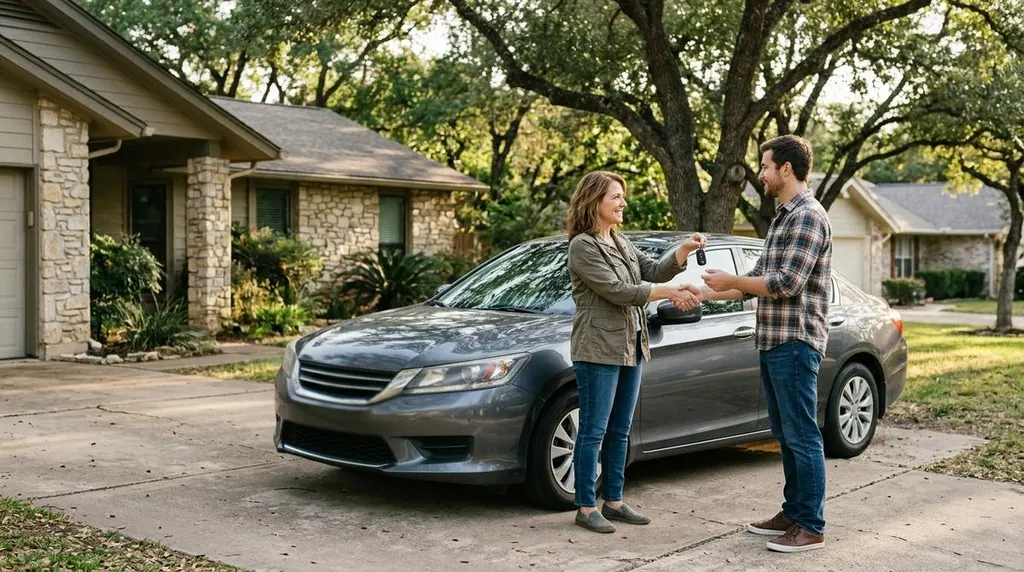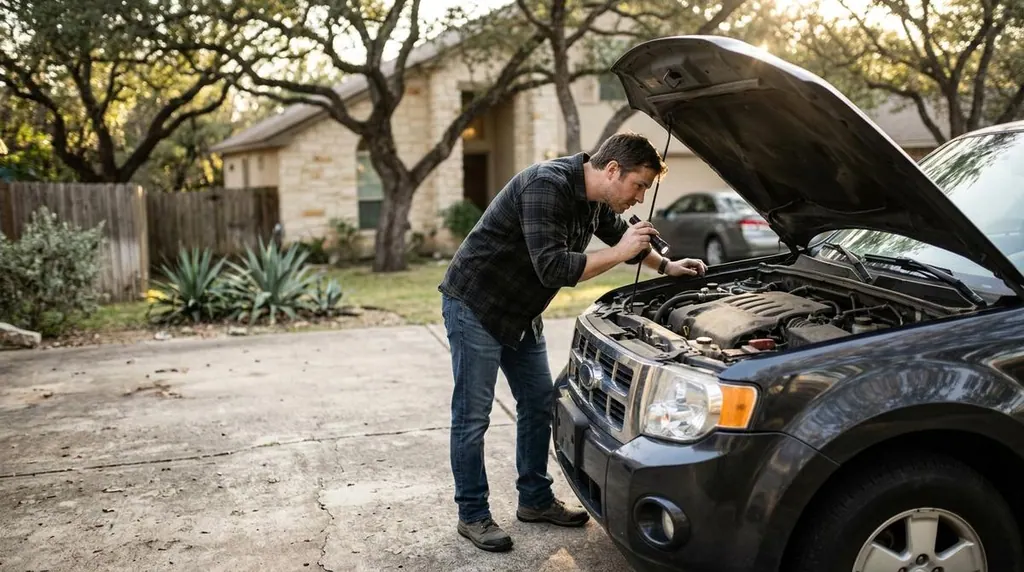
Curbstoning is when someone sells cars as a business without a Texas dealer license, usually while posing as a private owner. The fastest way to spot it is to check whose name is on the title: a real private seller sells a car titled and registered in their own name. If the name on the title is someone else's, or the same person has a string of cars for sale, treat the deal as high risk.
TxDMV defines curbstoning as the unlawful act of selling vehicles somewhere other than licensed premises, such as repeated unlicensed flipping of used cars for profit (TxDMV Motor Vehicle Dealer Manual).
Why curbstoning matters to a buyer
According to TxDMV, buyers from curbstoners risk getting:
- A car without good title.
- A salvage vehicle that cannot lawfully be driven.
- A stolen vehicle.
A curbstoner also skips the duties a licensed dealer has. Licensed dealers that sell more than five used cars in 12 months must post an FTC Buyers Guide on each car (FTC), and Texas dealers must process title and registration within set deadlines (TxDMV). An unlicensed seller does neither, and TxDMV's dealer complaint process is built around licensed dealers.
What Texas law says
The license requirement
Texas Transportation Code 503.021 says a person "may not engage in business as a dealer, directly or indirectly, including by consignment, without a dealer general distinguishing number" for each location they sell from (Transportation Code Chapter 503). That number is called a GDN.
The fewer-than-five exclusion
Ordinary people selling their own cars do not need a GDN. Section 503.024(a) says a person is not required to obtain one if the person "sells or offers to sell during a calendar year fewer than five vehicles of the same type that are owned and registered in that person's name" (Transportation Code Chapter 503).
Read the two conditions together:
- Fewer than five vehicles of the same type in a calendar year.
- Owned and registered in that person's name.
So a person who sells five or more of the same type in a calendar year, or who sells cars that are not titled and registered in their own name, falls outside the exclusion and needs a GDN. Section 503.024(b) adds limited exclusions for vehicles acquired for personal or business use. Government agencies are also excluded.
This guide explains the rule for buyers. It is not legal advice about any specific seller.
The title-in-the-seller's-name check
This one check catches most curbstoning, because it tests the second condition of 503.024 directly.
- Ask for a photo of the front of the title before you meet. Note the owner's name.
- At the meeting, compare the title with the seller's photo ID. The names should match.
- Compare the title with the registration. TxDMV advises buyers to make sure "the title and registration match the name and address of the person selling the car" (TxDMV).
- Look at the back of the title. If it is already signed by an owner who is not the person in front of you, or the buyer line is left blank for you to fill in, the seller never put the car in their own name.
- Check the VIN on the car against the title. TxDMV says to confirm the VIN is "present, secure and unaltered."
If the seller says the car belongs to a friend, a cousin or a customer, ask for the owner to be present, or for a signed power of attorney you can verify at the county tax office. A seller who cannot explain the gap is a reason to walk away.
Warning signs of a curbstoner
| Sign | Why it matters |
|---|---|
| The name on the title is not the seller's | Fails the "owned and registered in that person's name" condition |
| Title is signed by a previous owner and left open | The seller skipped titling it, which also skips sales tax and the paperwork trail |
| The same phone number appears on several car ads | Suggests a business selling many vehicles |
| Seller wants to meet in a parking lot, never at home | TxDMV warns about sellers with no fixed address, workplace or phone number |
| Price far below similar cars | TxDMV warns about deals that seem too good to be true |
| Seller pushes you to pay fast, in cash, or by wire or gift card | The FTC lists rushing and wire or gift card payment as scam signs (FTC) |
| Seller refuses an inspection or a trip to the tax office | Removes your two best chances to catch a problem |
| Seller knows little about the car's history | An owner usually knows how they used the car |
One sign alone does not prove anything. Several together are a strong reason to walk away.
How to protect yourself
- Run the VIN before you meet. Use TxDMV Title Check for salvage, flood and other brands, and NICB VINCheck for theft records reported by participating insurers. See free VIN check tools.
- Do the title-name check above.
- Get an independent inspection. Use our pre-purchase inspection checklist.
- Finish the deal at the county tax office. TxDMV recommends buyer and seller go together so a tax office representative can check the title for salvage or legal problems before it is submitted.
- Keep written records. TxDMV advises keeping a written record with the seller's name and address.
- Do not pay until you hold a properly signed title and Form 130-U. See documents you need to buy a car in Texas.
If you suspect a seller is an unlicensed dealer, you can contact TxDMV through its complaints page. Include the seller's contact details, the ad, and the VIN or plate number.
What if you already bought from a curbstoner?
Go to your county tax office with every document you have. They can tell you whether the title can be transferred. If the title cannot be transferred, read lost or bonded title in Texas and consider talking to a lawyer about your options. If the car turns out to be a branded salvage vehicle, see rebuilt and salvage titles in Texas.
For the full safe-purchase process, read buying from a private seller in Texas.
Curbstoning in Texas, step by step: how to vet a private seller
Use this order from the first message to the day you file. Each step either confirms the seller is a real owner or gives you an early exit.
- Save the ad. Take screenshots of the listing, the seller's profile and the phone number. If the deal goes wrong, this is what TxDMV or the county will ask for.
- Search the phone number and the photos. If the same number or the same driveway shows up on several different cars, that matches the "several car ads" warning sign above.
- Ask three questions in writing. Is the title in your name? Is there a lien on it? Will you finish the paperwork with me at the county tax office? A written answer gives you the record TxDMV suggests you keep.
- Get the VIN and a photo of the front of the title. Run TxDMV Title Check and NICB VINCheck before you drive anywhere.
- Meet in daylight and do the title-name check. Compare the title, the registration and the seller's photo ID.
- Test drive and inspect. Use the test drive checklist and book a mechanic you pick, not one the seller suggests.
- Sign the paperwork the right way. In a private sale, the seller signs the title over to you with the date of sale and odometer reading, and signs Form 130-U showing the sales price (TxDMV).
- File within 30 days. The buyer must title the car within 30 days of the date of sale. Filing on day 31 or later adds a delinquent transfer penalty that starts at $25 and can reach $250 (TxDMV Motor Vehicle Title Manual).
If a seller balks at steps 3, 4, 5 or 7, you have your answer.
Common mistakes that help a curbstoner
These are the patterns that turn a cheap car into an expensive problem.
- Accepting an "open" title. A title signed by a previous owner, with the buyer line blank, means the person selling never put the car in their name. You become the first link in a paper trail you cannot verify.
- Paying a deposit to "hold" the car. A deposit before you see the title and the car together gives the seller your money and gives you nothing.
- Trusting a report the seller sends you. Screenshots can be old or belong to another VIN. Run the VIN yourself.
- Writing a lower price on Form 130-U. It does not lower the tax the way people think. In a private sale, the county taxes the greater of the price you paid or 80 percent of the car's Standard Presumptive Value (Texas Comptroller).
- Skipping the tax office visit. TxDMV recommends that buyer and seller go together so a tax office representative can check the title before it is submitted (TxDMV).
- Waiting too long to file. The 30-day clock and the sales tax clock run whether or not the seller answers your calls.
Worked example: what the paperwork costs either way
The numbers below are made up to show how the official rules work. Your car, price and county will differ.
Say you agree to pay $9,000 for a used sedan, and its Standard Presumptive Value is $15,000.
| Item | How it is figured | Hypothetical amount |
|---|---|---|
| Taxable value | Greater of $9,000 or 80% of $15,000 ($12,000) | $12,000 |
| Motor vehicle sales tax | 6.25% of the taxable value (Comptroller) | $750 |
| Title application fee | $33 in Travis, Williamson, Hays, Caldwell, Comal, Guadalupe and Bexar (TxDMV Title Manual) | $33 |
| Tax paid 1 to 30 days late | 5% penalty (Comptroller) | $37.50 |
| Title filed on day 45 | Delinquent transfer penalty | $25 |
If you paid less than 80 percent of SPV, a certified appraisal on Form 14-128 obtained within 30 calendar days can set the taxable value, but not below the price paid (Comptroller). Registration fees come on top; see how to register a used car in Texas.
The point: a legitimate seller and a curbstoner cost you the same tax. The difference is that only the legitimate seller gives you a title the county can transfer.
Local notes for Austin and San Antonio
You can finish a private sale at any county tax office location that handles title transfers. In the corridor:
- Travis County: the main office is at 2433 Ridgepoint Dr, Austin, with walk-in title and registration on weekdays. The county also lists offices in Pflugerville, Northwest Austin, Southeast Austin near the airport, Oak Hill and East Austin, but drive-thru branches mainly handle renewals (Travis County Tax Office). The county site also posts identification requirements for some vehicle transactions, so bring your photo ID and check before you go.
- Bexar County: the main office is at 233 N Pecos La Trinidad, San Antonio (210-335-2251), with branches on Nacogdoches Rd, Bandera Rd, Pleasanton Rd and in Converse (Bexar County Tax Office).
- Comal and Guadalupe: Comal County does not take vehicle titles after 4 p.m. without an appointment, and Guadalupe County does not process titles after 4 p.m., so plan a morning meeting (Comal County, Guadalupe County).
Meeting at the tax office is also a simple test. A real owner rarely minds. Area pages: Central Austin, Round Rock, Central San Antonio.
What I would do
If I were buying from a private seller in Austin or San Antonio, I would not drive out until I had the VIN, a photo of the title and a written yes to meeting at the tax office. Those three things filter out most of the bad deals for free.
I would never hand over money for a car whose title shows someone else's name, no matter how good the price is. A price far below similar cars is exactly what TxDMV tells buyers to be careful about.
I would pay by a traceable method and get a dated, signed bill of sale on top of the title and Form 130-U. And I would rather lose a "great deal" than spend months trying to get a title the county will not transfer.
Sources
- TxDMV Motor Vehicle Dealer Manual (2026 edition)
- Texas Transportation Code Chapter 503 (503.021, 503.024)
- TxDMV - Buying or Selling a Vehicle
- TxDMV - Title Check: Look Before You Buy
- TxDMV - Complaints
- FTC - Dealer's Guide to the Used Car Rule
- FTC - Put the brakes on phony online car sales
- NICB - VINCheck
- Texas Comptroller - Private-Party Purchases and Standard Presumptive Values
- Texas Comptroller - Motor Vehicle Sales and Use Tax
- TxDMV Motor Vehicle Title Manual (August 2026)
- Travis County Tax Office - Visit us
- Bexar County Tax Office - Locations and hours
- Comal County Tax Office - Locations
- Guadalupe County Tax Assessor-Collector
Frequently asked questions
Is it illegal to flip cars in Texas?
Engaging in business as a dealer without a GDN is prohibited by Transportation Code 503.021. A person who sells fewer than five vehicles of the same type in a calendar year, owned and registered in their own name, does not need a GDN (Transportation Code 503.024).
What does curbstoning mean?
TxDMV defines it as selling vehicles somewhere other than licensed premises, such as repeated unlicensed flipping of used cars for profit (TxDMV Dealer Manual).
Can I buy a car from someone whose name is not on the title?
It is risky. TxDMV advises that the title and registration match the seller's name and address. If they do not, the seller may not have the right to sell, or may be an unlicensed dealer.
How can I check if a car is stolen?
Use NICB VINCheck, which shows whether participating insurers reported the car stolen and not recovered. NICB says it is not a full history report, so also run Title Check and get an inspection.
Where do I report a suspected curbstoner in Texas?
Contact TxDMV through its complaints page, with the ad, the seller's contact details and the VIN or plate number.
Does a curbstoner have to give me an FTC Buyers Guide?
The FTC Used Car Rule covers dealers who sell more than five used vehicles in 12 months, and it does not cover private sellers (FTC). A curbstoner posing as a private owner almost never posts one, which is one more reason the title-name check matters.
Educational content. Anthony does not sell, broker or arrange vehicle sales in Texas. Confirm fees and rules with the office named in each source before you pay anything.