To buy a used car in Texas, you have four jobs: set a full budget that includes tax and fees, check the car's history and condition before you pay, collect the right paperwork, and title and register the car in your name within 30 days. This guide walks through each step in order and links to a deeper guide for each one.
The steps are the same whether you live in Austin, San Antonio or a town between them. What changes is who handles the paperwork (a licensed dealer or you), and whether your county requires an emissions test.
Step 1: Set a budget that includes Texas tax and fees
The price on the windshield is not the price you pay. Before you shop, add the costs Texas charges on every used car purchase.
| Cost | Amount | Source |
|---|---|---|
| Motor vehicle sales tax | 6.25 percent of the sales price minus any trade-in allowance | Texas Comptroller |
| Title application fee | $33 in nonattainment or affected counties, $28 elsewhere, based on where you live | TxDMV Title Manual |
| Base registration (passenger car or truck 6,000 lbs. or less) | $50.75 per year, plus $1 TexasSure, plus local county fees | TxDMV fee chart |
| Inspection program replacement fee | $7.50 at registration ($16.75 for a vehicle never registered before) | Texas DPS |
Every county in the Austin to San Antonio corridor (Travis, Williamson, Hays, Caldwell, Bastrop, Comal, Guadalupe, Bexar and Wilson) pays the $33 title fee, according to the TxDMV Title Manual. Local registration fees differ by county; the TxDMV fee chart lists them.
In a private sale, sales tax is calculated on the greater of the price you paid or 80 percent of the car's Standard Presumptive Value (SPV), per the Comptroller's SPV page. If you pay a low price on a car, budget for tax on the SPV figure. Our Texas car sales tax guide explains how SPV and appraisals work.
Also budget for:
- Insurance. Texas requires at least 30/60/25 liability coverage: $30,000 per injured person, up to $60,000 per accident, and $25,000 for property damage (Texas Department of Insurance). Get a quote on the exact car before you buy it.
- Emissions testing, if you live in Travis, Williamson or Bexar County (see Step 9).
- A pre-purchase inspection by an independent mechanic.
- Repairs and maintenance the inspection turns up.
Example: adding up the state charges
The car price here is hypothetical; the fees are the official amounts above. Say you buy a used car from a private seller for $12,000, and 80 percent of its SPV is lower than that.
| Item | Travis County resident | Bexar County resident |
|---|---|---|
| Sales tax (6.25% of $12,000) | $750 | $750 |
| Title application fee | $33 | $33 |
| Base registration | $50.75 | $50.75 |
| TexasSure | $1 | $1 |
| Inspection program replacement fee | $7.50 | $7.50 |
| Local county fee | $11.50 | $21.50 |
| Total of these items | $853.75 | $863.75 |
Both counties also require an emissions test (station charge up to $11.50 in Travis and $18.50 in Bexar), and Bexar owners pay $2.75 to the state at renewal (Texas DPS). Your county may add a processing fee. Use the example to see the shape of the bill, not as a quote.
If you plan to finance, read used car financing basics before you shop so you know what to compare. For a longer view of running costs, see the cost of owning a used car in Texas.
Step 2: Choose the right car for how you drive
Start with your needs, not a listing. Write down:
- How many people and how much cargo you carry most days.
- Your daily commute and highway use, including toll roads.
- Whether you tow, park on the street, or drive rough roads.
- Your must-have safety features.
- The most you can pay out the door, including tax and fees.
Then narrow to two or three models. Our car data pages collect recall and complaint information for common models, such as the Toyota Camry, Ford F-150 and Honda Civic. Knowing a model's known problems before you look helps you ask better questions. Our guide on how to read NHTSA complaint data shows how to interpret those numbers.
Texas conditions matter too. Some used cars have been through floods or hail, and summer heat makes a working air conditioner essential. See used cars and Texas heat and how to spot a flood-damaged car.
Step 3: Decide where to buy
You can buy from a licensed dealer, a private seller, or an auction. Each one changes who does the paperwork and what protections you get.
- Licensed dealer. Dealers that sell more than five used cars in 12 months must post an FTC Buyers Guide on each car showing whether it is sold "As Is" or with a warranty (FTC). The dealer collects sales tax, issues metal plates at the time of sale (TxDMV HB 718), and processes your title and registration.
- Private seller. Usually the lowest price, but the FTC Used Car Rule does not cover private sellers, and you handle the title transfer and tax yourself.
- Auction. Rules vary by auction. Many are dealer-only.
Compare them in dealer vs private seller in Texas, and read how car auctions work in Texas if you are considering one.
Watch for a seller who acts like a dealer without a license. Texas law requires a dealer license (a general distinguishing number, or GDN) to be in the business of selling cars (Transportation Code 503.021). Our curbstoning guide explains the warning signs.
Step 4: Check the VIN before you see the car
Ask the seller for the 17-character vehicle identification number (VIN) before you drive out to look. Then run three checks:
- Title brands. TxDMV Title Check uses NMVTIS, the national title database, to show brands such as salvage, junk, rebuilt, water damage, odometer and manufacturer buyback, and whether an insurer declared the car a total loss.
- Open recalls. Enter the VIN at NHTSA.gov/recalls. Federal law does not require dealers to fix recalls on used cars before selling them (FTC).
- Theft and insurer records. The free NICB VINCheck shows whether participating insurers reported the car stolen and not recovered, or as salvage or flood damaged.
A clean result does not prove a clean history. TxDMV notes that some states do not brand flood damage and titles can be "washed" through other states. See free VIN check tools, how to check recalls and how to check a Texas title for salvage and flood damage.
Step 5: Inspect the car in person
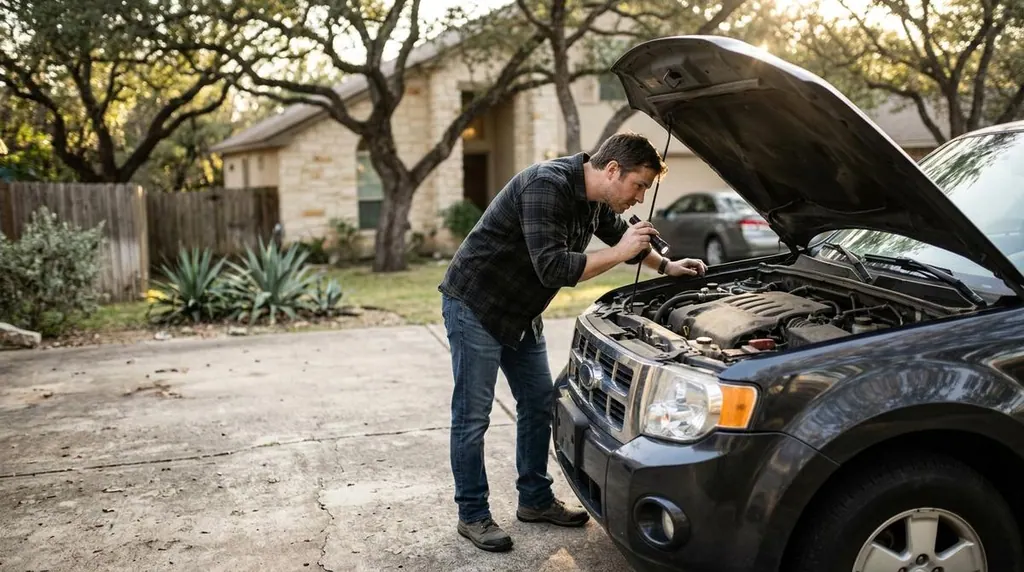
Look at the car in daylight, on a dry day, with the engine cold. Check that the VIN on the dashboard and door jamb matches the VIN on the title and your reports. TxDMV advises buyers to confirm the VIN is "present, secure and unaltered" (TxDMV).
Then take the car to an independent mechanic you choose. The FTC calls a mechanical inspection "a good idea even if the car has been certified and inspected by the dealer" (FTC). This matters more in Texas now: since January 1, 2025, non-commercial vehicles no longer need a state safety inspection to register (Texas DPS), so there is no recent inspection sticker to lean on.
Use our pre-purchase inspection checklist for what to look at and what to ask the mechanic.
Step 6: Test drive with a plan
A short loop around the block hides problems. Drive the car at city and highway speeds, over rough pavement, and in stop-and-go traffic. Test the air conditioning, every window and lock, and the brakes. Our test drive checklist lists what to check in order.
Step 7: Verify the mileage and the seller
Compare the odometer reading with the mileage on the title, service records and history reports. For model year 2011 and newer vehicles, federal rules require a written odometer disclosure on transfer until the vehicle is 20 years old (NHTSA). Read odometer fraud: how to check.
In a private sale, make sure "the title and registration match the name and address of the person selling the car," as TxDMV advises. Be wary of a seller with no fixed address, workplace or phone number, and of any deal that seems too good to be true.
Step 8: Negotiate and understand what you are signing
Use the inspection report and your research to negotiate. Repair estimates from your mechanic are fair grounds for a lower price. Our negotiation guide covers how to make an offer.
Before you sign at a dealer, read the Buyers Guide. It overrides contrary terms in the sales contract, and any warranty changes you negotiate must appear on it (FTC). If the box says "As Is - No Dealer Warranty," the dealer will not pay for repairs after the sale. Texas law allows "as is" sales (Business and Commerce Code 2.316). Learn the details in Buyers Guide, as is and used car warranties.
Do not count on the Texas Lemon Law for a used car. It covers defects under the manufacturer's written warranty, so a used car qualifies only if it is still under that original warranty (TxDMV Lemon Law). See does Texas have a used car lemon law.
Step 9: Collect the paperwork
In a private sale, get these before you hand over the money (TxDMV):
- The title, properly signed by the seller, with the date of sale and odometer reading.
- Form 130-U, signed by the seller, with the sales price clearly shown.
- Any release of lien or power of attorney.
- A written record with the seller's name and address.
TxDMV recommends that buyer and seller go to the county tax office together so a representative can check the title for salvage or legal problems before you submit it. Our documents checklist covers every form.
If the private seller keeps the license plates, you can get a free Vehicle Transit Permit online to drive home. It is valid for 5 calendar days (TxDMV). See temporary tags after buying a car in Texas.
Step 10: Title, tax and register within 30 days
From a dealer: The dealer generally must process title and registration within 30 days, or 45 days if the dealer provided financing. If that time passes, you can file a complaint with TxDMV.
From a private seller: You must title the car in your name within 30 days from the date of sale at your county tax assessor-collector's office (TxDMV). Filing on day 31 or later adds a $25 delinquent transfer penalty, plus $25 for each additional 30 days or part of 30 days, up to $250. The county cannot waive it (TxDMV Title Manual). Sales tax is due within 30 calendar days too, with a 5 percent penalty for paying 1 to 30 days late and 10 percent after that (Comptroller). Active-duty military get 60 days for both.
Emissions: Travis, Williamson and Bexar counties are emissions counties. Bexar joined the list on November 1, 2026 (TCEQ). Gasoline vehicles 2 through 24 years old must pass a yearly emissions test before registration there. Hays, Comal, Guadalupe and Caldwell are not on the list. Read Texas inspection and emissions rules.
Bring proof of Texas liability insurance. TxDMV says to allow a minimum of 20 business days for the title to be processed. Our title transfer step-by-step and how to register a used car in Texas guides cover the counter visit.
Where to title and register between Austin and San Antonio
After a private sale you file at the tax office of the county where you live. These are the main offices; each county also lists branches on its site.
| County | Main office | Emissions test? |
|---|---|---|
| Travis | 2433 Ridgepoint Dr, Austin | Yes |
| Williamson | 1848 Texas Trail, Georgetown | Yes |
| Hays | 712 S Stagecoach Trail, San Marcos | No |
| Caldwell | 110 S Main St, Lockhart | No |
| Comal | 205 N Seguin Ave, New Braunfels | No |
| Guadalupe | 307 W Court St, Seguin | No |
| Bexar | 233 N Pecos La Trinidad, San Antonio | Yes, from Nov. 1, 2026 |
Check hours before you go. Comal County, for example, does not take vehicle titles after 4 p.m. without an appointment (Comal County). Your area page lists the nearest branch.
Common mistakes when you buy a used car in Texas
- Shopping by monthly budget instead of the total. Add tax, title, registration and insurance to the price before you decide what you can afford.
- Running the VIN checks after you fall for the car. Run Title Check, recalls and NICB before you drive out to see it.
- Trusting the listing's VIN. Copy it from the dashboard and door jamb and match it to the title.
- Skipping the independent inspection. The state no longer does a safety inspection on non-commercial vehicles, so no one else is checking.
- Signing at a dealer without reading the Buyers Guide. It controls over the contract on warranty terms (FTC).
- Buying from someone whose name is not on the title. Stop and find out why.
- Missing the 30-day title and tax window. Two separate penalties can start on day 31.
- Forgetting emissions in Travis, Williamson or Bexar. A car that cannot pass cannot be registered there.
- Driving home uninsured. Add the car to your policy before you move it.
What I would do if I were buying today
I live in Austin, and if I were buying a used car this month, I would start with a spreadsheet, not a listing. I would write down the most I could spend out the door, then subtract tax and fees to get my real price ceiling.
Then I would shortlist two or three models and read their recall and complaint history on our car data pages. I would ask every seller for the VIN first and run it before I spent a Saturday driving to see the car. I would only go look at cars that passed those checks.
At the car, I would match the VINs, check the title name against the seller's ID, and take it to a mechanic I picked. I would not negotiate until I had that report in hand. If it was a private sale, I would finish at the county tax office with the seller, and I would file everything in the first week rather than the last.
None of that is complicated. It is just doing the steps in the right order, and not letting a good price rush you past them.
Quick checklist
- Budget for 6.25 percent sales tax, the $33 or $28 title fee, registration, insurance and an inspection.
- Shortlist two or three models and read their recall and complaint data.
- Get the VIN and run Title Check, NHTSA recalls and NICB VINCheck.
- Confirm the seller's name matches the title.
- Inspect the car and have an independent mechanic check it.
- Test drive on city streets and highway.
- Compare odometer readings across the title and records.
- Read the Buyers Guide or the written agreement before you sign.
- Collect the signed title, Form 130-U and any lien release.
- Title and pay tax within 30 days, pass emissions if required, and register.
Sources
- Texas Comptroller - Motor Vehicle Sales and Use Tax
- Texas Comptroller - Private-Party Transactions and Standard Presumptive Value
- TxDMV Motor Vehicle Title Manual
- TxDMV Texas Registration Fees chart
- TxDMV - Buying or Selling a Vehicle
- TxDMV - Title Check: Look Before You Buy
- TxDMV - Temporary Registration
- TxDMV - House Bill 718
- TxDMV - Complaints
- TxDMV - Lemon Law
- Texas DPS - Vehicle Safety Inspection Program Changes
- Texas DPS - Cost of Inspection
- County tax office pages: Travis, Williamson, Hays, Caldwell, Comal, Guadalupe, Bexar
- TCEQ - Vehicle Emissions Inspection Program overview
- Texas Department of Insurance - Auto insurance guide
- Texas Transportation Code Chapter 503
- Texas Business and Commerce Code Chapter 2
- FTC - Dealer's Guide to the Used Car Rule
- FTC - Buying a Used Car From a Dealer
- FTC - Buying a Used Car (PDF)
- NHTSA - Recalls
- NHTSA - Changes to Odometer Disclosure Requirements
- NICB - VINCheck
Frequently asked questions
How long do I have to transfer a title after buying a used car in Texas?
In a private sale, you must title the car in your name within 30 days from the date of sale (TxDMV). Active-duty military get 60 days. A dealer handles this for you.
How much is sales tax on a used car in Texas?
It is 6.25 percent of the sales price minus any trade-in allowance (Comptroller). In a private sale, tax is based on the greater of the price paid or 80 percent of the Standard Presumptive Value.
Does a used car need a safety inspection in Texas?
Not for non-commercial vehicles since January 1, 2025 (Texas DPS). Emissions testing still applies in emissions counties, including Travis, Williamson and Bexar.
Is it safer to buy from a dealer or a private seller?
A licensed dealer must post an FTC Buyers Guide and handle title paperwork, which adds protection. A private sale can cost less but is usually as is, and you handle the paperwork. Our dealer vs private seller guide compares them.
Do I need an emissions test if I live in Hays or Comal County?
No. Hays, Comal, Guadalupe and Caldwell counties are not on the state emissions list, so non-commercial vehicles there need neither a safety inspection nor an emissions test to register (TCEQ). You still pay the $7.50 inspection program replacement fee.
What insurance do I need before I register a used car?
At least 30/60/25 liability coverage, and you must show proof of insurance to register (Texas Department of Insurance).
Educational content. Anthony does not sell, broker or arrange vehicle sales in Texas. Confirm fees and rules with the office named in each source before you pay anything.