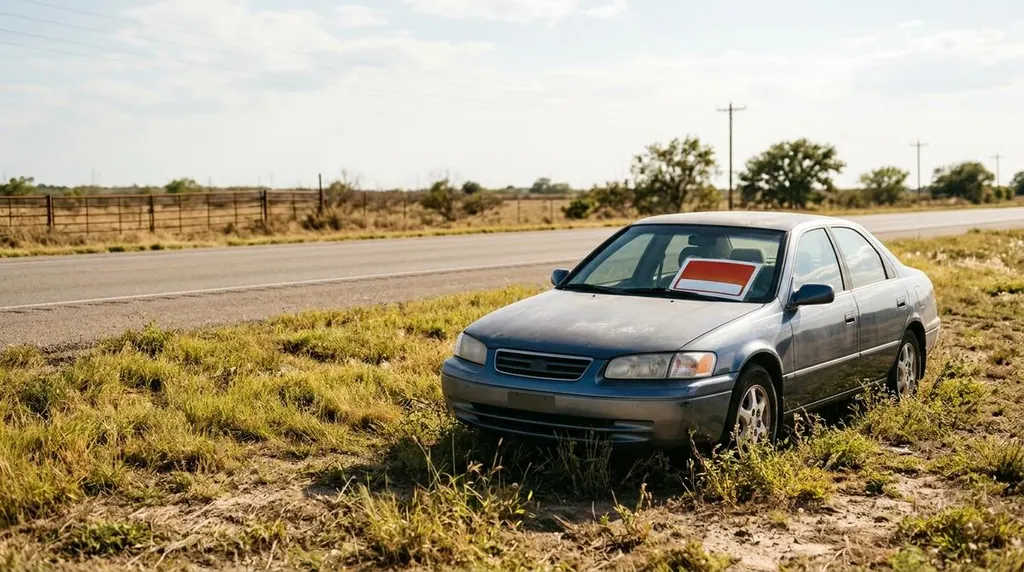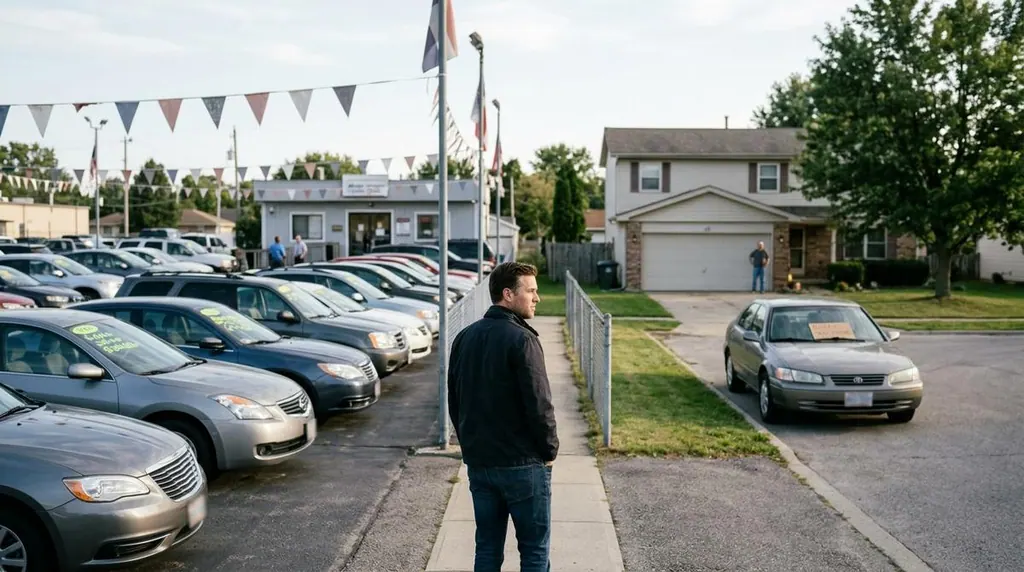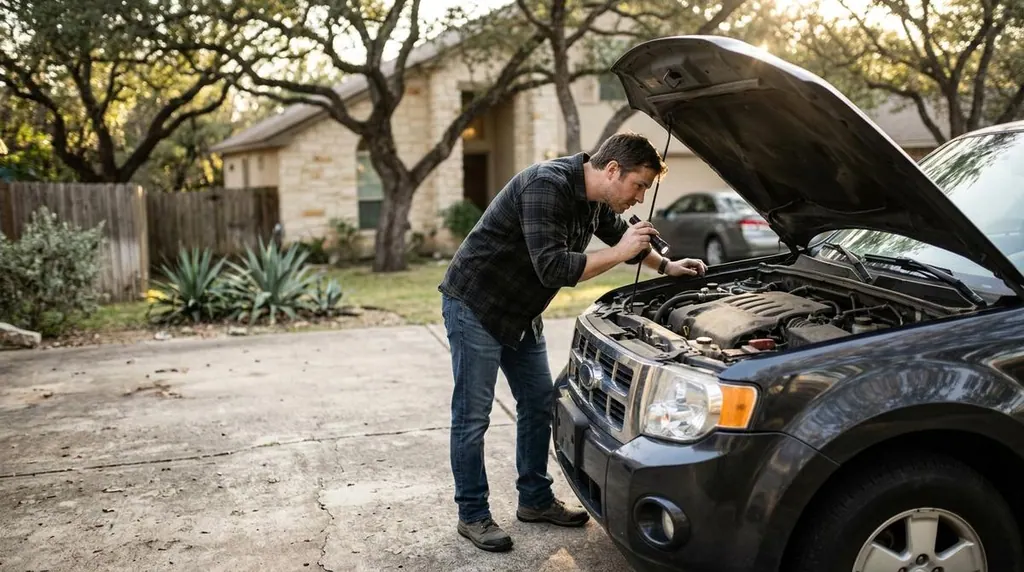
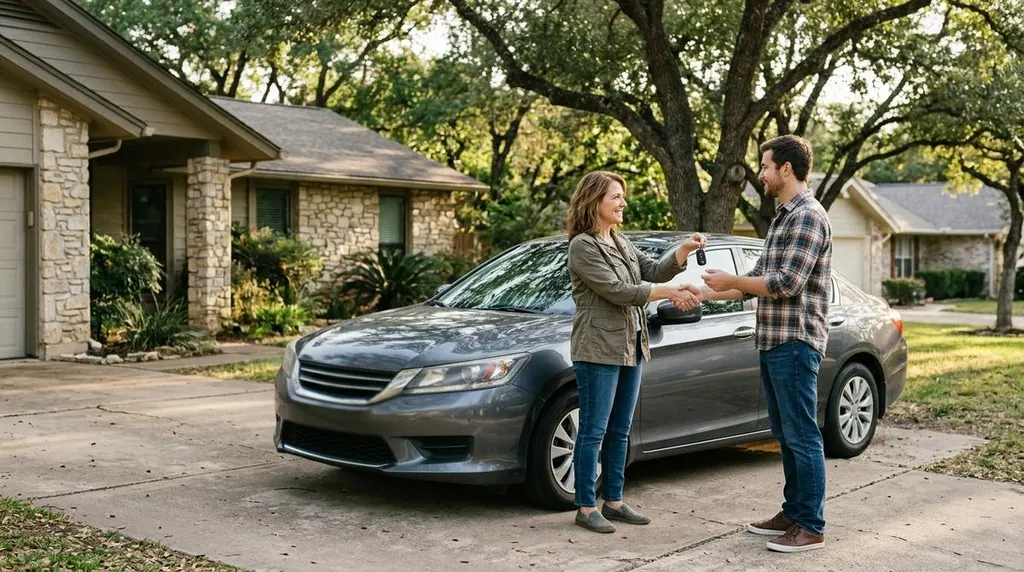
To buy from a private seller in Texas, confirm the seller's name is on the title, check the VIN for brands and recalls, have a mechanic inspect the car, and leave with a signed title and a signed Form 130-U. You then have 30 days from the date of sale to title the car and pay sales tax at your county tax office. Unlike a dealer, the seller does none of that filing for you.
A private sale can save money, but most of the protections of a dealer sale are missing. This guide shows what to check and in what order.
What changes when there is no dealer
| Topic | Private sale in Texas |
|---|---|
| Warranty | Usually none. A private sale "probably will be on an 'as is' basis" unless your written agreement says otherwise (FTC). |
| FTC Buyers Guide | Not required. The FTC Used Car Rule does not cover private sellers (FTC). |
| Sales tax | You pay 6.25 percent at the county tax office, on the greater of the price or 80 percent of Standard Presumptive Value (Comptroller). |
| Title filing | You file within 30 days of the sale (TxDMV). |
| License plates | The seller usually removes the plates and registration sticker at delivery (TxDMV press release, June 10, 2025). |
For a side-by-side view, see dealer vs private seller in Texas.
Step 1: Screen the listing and the seller
Before you drive anywhere, ask the seller for:
- The 17-character VIN.
- A photo of the front of the title showing the owner's name.
- Whether there is a loan on the car (a lien) and, if so, how it will be released.
- Service records they have.
Then watch for red flags. TxDMV warns buyers to be wary of a seller with "no fixed address, place of employment or phone number," and of a deal that seems too good to be true (TxDMV). The FTC adds sellers who will not let you see or inspect the car, who rush you, or who ask for payment by gift card or wire transfer (FTC).
If the same person has several cars for sale, none in their own name, you may be dealing with an unlicensed dealer. Read curbstoning in Texas.
Step 2: Run the VIN
Run these checks on the VIN the seller gave you:
- TxDMV Title Check, which uses the national NMVTIS database and shows brands such as salvage, junk, rebuilt, water damage, odometer and manufacturer buyback, plus insurer total-loss records. Reports come from approved providers for a fee.
- NHTSA recall lookup for open safety recalls.
- NICB VINCheck for theft and insurer salvage records.
Details are in free VIN check tools.
Step 3: Inspect the car and the paperwork together
Meet in daylight in a public place. Bring a friend. Then check:
- The VIN matches. Compare the VIN on the dashboard and door jamb with the title. TxDMV says to confirm the VIN is "present, secure and unaltered."
- The name matches. TxDMV advises that "the title and registration match the name and address of the person selling the car." Ask to see the seller's photo ID and compare it with the title.
- The title is clean of surprises. Look for a lienholder listed on the title. If there is one, you need a release of lien.
- The mileage makes sense. Compare the odometer with the records.
Then take the car to an independent mechanic. You can ask a private seller to allow this even though they are not required to (FTC). A seller who refuses is a reason to walk away. Use our pre-purchase inspection checklist.
Step 4: Agree on price and write it down
Use the mechanic's report to negotiate. Put the deal in writing: buyer and seller names, VIN, price, date, and that the sale is as is if that is the agreement. A written agreement is the main record you have if something goes wrong.
Write the true price on Form 130-U. In a private sale, the county taxes the greater of the price paid or 80 percent of SPV. If you paid less than 80 percent of SPV, a certified appraisal (Form 14-128) obtained within 30 calendar days can set the taxable value, but not below the price paid (Comptroller). Read the Texas car sales tax guide.
Step 5: Collect the right documents at payment
Do not hand over money until you hold these (TxDMV):
- The title, properly signed by the seller, with the date of sale and odometer reading.
- Form 130-U, signed by the seller, with the sales price clearly shown.
- A release of lien, if the title shows a lienholder.
- A power of attorney, if someone other than the owner is signing.
- A written record with the seller's name and address.
- The seller's most recent vehicle inspection report, if the state database has no current record.
For model year 2011 and newer vehicles, the seller must give a written odometer disclosure until the vehicle is 20 years old (NHTSA). On a Texas title, that is the odometer section the seller fills in.
The safest way to finish is to go to the county tax office together. TxDMV recommends this "to avoid unwanted surprises," because a tax office representative can check the title for salvage or legal problems before it is submitted.
Step 6: Get the car home legally
You need insurance before you drive. Texas requires at least 30/60/25 liability coverage (TDI).
If the seller removes the plates, you can get a free Vehicle Transit Permit online. It is valid for 5 calendar days, one per vehicle sale, for passenger vehicles of 6,000 lbs. or less and light trucks of 10,000 lbs. GVW or less. It is not available for salvage or nonrepairable vehicles (TxDMV).
Step 7: Title, tax and register within 30 days
File at your county tax assessor-collector's office within 30 days of the sale. Bring the signed title, Form 130-U, proof of insurance and payment for tax and fees. Confirm the total and accepted payment methods with your county tax office first.
- Title fee: $33 in every Austin to San Antonio corridor county (TxDMV Title Manual).
- Late title penalty: $25 starting on day 31, plus $25 for each further 30 days or part of 30 days, up to $250. The county cannot waive it.
- Late tax penalty: 5 percent if 1 to 30 days late, 10 percent after that (Comptroller).
- Emissions: If you live in Travis, Williamson or Bexar County, pass an emissions test before registration (TCEQ).
TxDMV says to allow at least 20 business days for title processing. Walk through the counter visit in Texas title transfer step by step.
Example: how the late penalties stack up
These numbers are hypothetical and only show how the official rules combine. Say the tax due on your car works out to $600.
| When you file | Title penalty | Sales tax penalty |
|---|---|---|
| Within 30 days of the sale | $0 | $0 |
| Day 45 after the sale | $25 | 5% of $600 = $30 |
| Day 75 after the sale | $50 (day 31 starts the first $25, day 61 adds another) | 10% of $600 = $60 |
The title penalty steps are from the TxDMV Title Manual and the tax penalty rates are from the Comptroller. The point is simple: a few weeks of delay can cost more than the title fee itself.
Where to finish the deal between Austin and San Antonio
You file in your county of residence, so the seller's county does not matter. These are the main county offices in the corridor. Most counties also run branches, and services differ by branch, so check the county page before you go.
| County | Main office | Branches listed by the county | Emissions test to register? |
|---|---|---|---|
| Travis | 2433 Ridgepoint Dr, Austin | Pflugerville, Northwest Austin, Southeast Austin, Oak Hill, East Austin | Yes |
| Williamson | 1848 Texas Trail, Georgetown | Round Rock, Cedar Park, Taylor | Yes |
| Hays | 712 S Stagecoach Trail, San Marcos | Kyle, Dripping Springs, Wimberley | No |
| Caldwell | 110 S Main St, Lockhart | Luling | No |
| Comal | 205 N Seguin Ave, New Braunfels | Sattler, Bulverde | No |
| Guadalupe | 307 W Court St, Seguin | Schertz | No |
| Bexar | 233 N Pecos La Trinidad, San Antonio | Northeast, Northwest, Southside, Precinct 4 (Converse) | Yes |
Emissions status is from the TCEQ county list. Bexar County was added starting November 1, 2026. Your nearest branch is also listed on your area page, for example Kyle or Seguin.
Buying from a private seller in Texas: mistakes to avoid
These are the mistakes that turn a cheap private sale into an expensive one.
- Paying before you hold the signed title. A promise to mail the title later is not a title. Do not pay without it.
- Accepting an "open" title. If the seller named on the front is not the person signing it to you, someone in the middle is skipping the transfer. That is a classic curbstoning sign.
- Ignoring a lienholder on the title. Without an original release of lien, the lender may still have a claim on the car.
- Writing a lower price on Form 130-U. The county taxes the greater of your price or 80 percent of SPV (Comptroller), so a low number does not help you, and a false number is its own problem.
- Skipping the inspection because the car "drives fine." Texas no longer requires a safety inspection for non-commercial vehicles (Texas DPS). Nobody checks the brakes or tires for you anymore.
- Waiting until day 29 to file. Counties have lines, and some limit late-day title work. Comal County, for example, does not take vehicle titles after 4 p.m. without an appointment (Comal County). File in the first week.
- Driving off uninsured. You need at least 30/60/25 liability coverage before you drive (TDI).
- Forgetting the emissions test in Travis, Williamson or Bexar County. A car that cannot pass will block your registration.
How I would handle payment and the handoff
This is my opinion, not a legal rule. I would not carry a large amount of cash to a stranger's driveway. I would meet in a public place, and if possible finish at the seller's bank or at the county tax office, where the title can be looked at before money moves. I would pay with a method that leaves a record, and I would get a simple written bill of sale with both names, the VIN, the price, the date and both signatures.
I would also refuse any deal where the seller wants payment by gift card or wire transfer, rushes me, or will not let me see the car in person. The FTC lists those as warning signs of fake online car sales (FTC).
Your first week after a private sale
- Call your insurer and add the car before you drive it.
- If the seller kept the plates, get the free 5-day Vehicle Transit Permit (TxDMV).
- In an emissions county, get the emissions test done.
- File the title, Form 130-U and payment at your county tax office.
- Sign up for NHTSA recall alerts and run a fresh recall check.
- Set up your toll account; see toll roads and TxTag.
- Remind the seller to file the Vehicle Transfer Notification, which protects them from tolls and tickets on the car after the sale.
Sources
- TxDMV - Buying or Selling a Vehicle
- TxDMV press release, June 10, 2025 (plates in private sales)
- TxDMV - Title Check: Look Before You Buy
- TxDMV - Temporary Registration
- TxDMV Motor Vehicle Title Manual
- Texas Comptroller - Motor Vehicle Sales and Use Tax
- Texas Comptroller - Private-Party Transactions and SPV
- TCEQ - Vehicle Emissions Inspection Program overview
- Texas Department of Insurance - Auto insurance guide
- FTC - Dealer's Guide to the Used Car Rule
- FTC - Buying a Used Car (PDF)
- FTC - Put the brakes on phony online car sales
- NHTSA - Recalls
- NHTSA - Changes to Odometer Disclosure Requirements
- NICB - VINCheck
- Texas DPS - Vehicle Safety Inspection Program Changes
- County tax office pages: Travis, Williamson, Hays, Caldwell, Comal, Guadalupe, Bexar
Frequently asked questions
Does a private seller in Texas have to give a warranty?
No. A private sale is usually as is unless your written agreement says otherwise, and the FTC Used Car Rule does not cover private sellers (FTC).
What if the seller's name is not on the title?
Do not buy until it is resolved. TxDMV advises that the title and registration match the seller's name and address. A person selling cars not titled in their own name may be acting as an unlicensed dealer.
Do I pay sales tax to the seller?
No. In a private sale, you pay the 6.25 percent tax to the county tax assessor-collector when you title the car (Comptroller).
Can I drive the car home without plates?
If the seller keeps the plates, get a free 5-day Vehicle Transit Permit online from TxDMV, and have insurance in place first (TxDMV).
Should I pay a private seller in cash?
That is your choice, but I would use a payment method that leaves a record and finish the deal at a bank or the county tax office. Never pay by gift card or wire transfer, which the FTC lists as scam warning signs (FTC).
What happens if I miss the 30-day title deadline?
A delinquent transfer penalty starts at $25 and can reach $250, and a separate penalty applies to late sales tax (TxDMV Title Manual).
Educational content. Anthony does not sell, broker or arrange vehicle sales in Texas. Confirm fees and rules with the office named in each source before you pay anything.