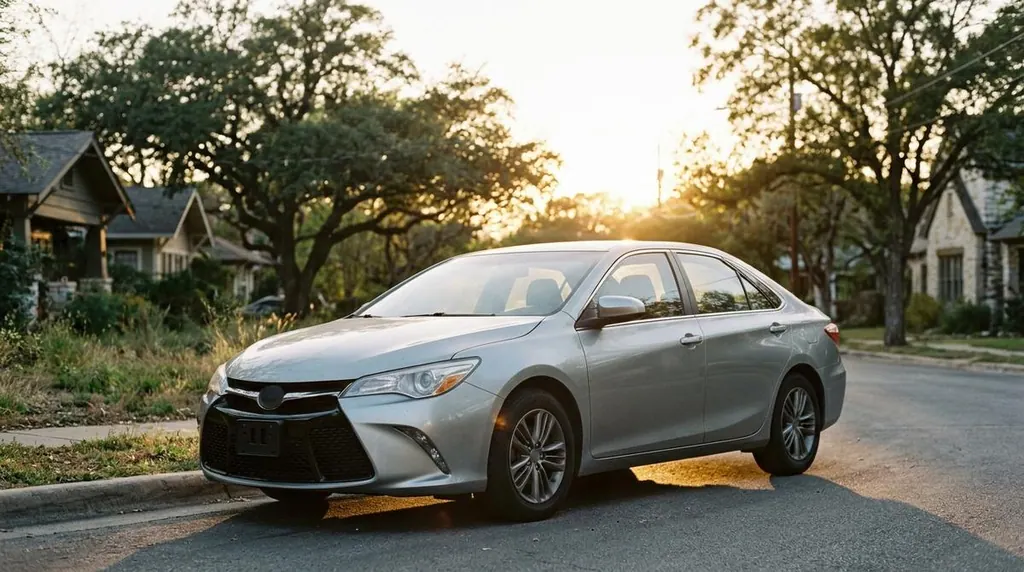
This used Toyota Camry review covers the 2015 to 2022 model years for Texas buyers. In NHTSA's records the 2016, 2017, 2021 and 2022 Camrys have the fewest complaints and the 2018 has by far the most, with power train and brakes leading. If I were shopping, I would look hardest at a 2021 or 2022, and at a 2016 or 2017 if the budget points older. Run the VIN for open recalls and get an inspection either way.
The evidence here is public data only: NHTSA recall, complaint and crash-test records pulled from api.nhtsa.gov on November 5, 2026, EPA fuel economy from fueleconomy.gov, and warranty terms from Toyota. No owner reviews, no invented reliability scores and no prices.
Where the Camry ranks in Texas sales
In CarEdge's best-selling new cars in Texas list, with data updated October 27, 2026, the Camry is number two with 7,879 new units sold in Texas over the previous 45 days. Only the Ford F-150 sold more, at 7,939, and the Camry is the only sedan in the top five. CarEdge builds the list from new-vehicle dealer inventory data, not registrations, so it is a new-car signal. For a used buyer, it means a steady supply of Camrys coming off leases, fleets and trade-ins, so you can afford to be picky about history and condition.
Toyota Camry years for used buyers: 2015 to 2022
The 2015 to 2022 span covers two designs. You can see the break clearly in the engine and transmission data on fueleconomy.gov.
2015 to 2017
These cars use a 2.5-liter four-cylinder or a 3.5-liter V6, both with a 6-speed automatic, and front-wheel drive only. The Camry Hybrid uses a 2.5-liter four with a continuously variable transmission. This is a simple, familiar layout, and the complaint counts for 2016 and 2017 are among the lowest in this span.
2018 to 2022
The 2018 model year brought the current-shape Camry. fueleconomy.gov lists new 2.5-liter four-cylinder and 3.5-liter V6 engines with both direct and port injection, an 8-speed automatic, and a much more efficient hybrid. All-wheel drive appears on four-cylinder trims from 2020. The first year of this design, 2018, is also the year with the most complaints and recall campaigns.
Used Camry review by year: recalls, complaints and crash ratings
This table comes from NHTSA records pulled November 5, 2026. The recall count is the number of recall campaigns that list the model year. Some campaigns cover only one engine, a short build window, or labels and spare tires added by regional distributors (Southeast Toyota and Gulf States Toyota appear in the records). The complaint count is every owner complaint filed for that year. "Unknown or other" is skipped when picking the top named component.
| Model year | Recall campaigns | Owner complaints | Crash / fire complaints | Top named complaint component (count) | NHTSA overall rating |
|---|---|---|---|---|---|
| 2015 | 1 | 271 | 33 / 3 | Steering (105) | 5 stars |
| 2016 | 2 | 189 | 41 / 2 | Air bags (31) | 5 stars |
| 2017 | 3 | 148 | 28 / 5 | Air bags (24) | 5 stars |
| 2018 | 8 | 754 | 46 / 4 | Power train (200) | 5 stars |
| 2019 | 6 | 403 | 22 / 1 | Power train (116) | 5 stars |
| 2020 | 3 | 276 | 14 / 2 | Electrical system (68) | 5 stars |
| 2021 | 1 | 158 | 21 / 2 | Air bags (78) | 5 stars |
| 2022 | 1 | 66 | 14 / 1 | Air bags (11) | 5 stars |
Rollover ratings in the same records are 4 stars for 2015-2017 and 5 stars for 2018-2022. Remember that older cars have had more years to collect complaints, and more popular years have more cars on the road, so raw counts are a starting point. My guide to reading NHTSA complaint data goes deeper, and you can check any VIN on NHTSA's recalls page.
The Camry recalls that matter most
Here are the campaigns I would confirm first, by year, using NHTSA's component names.
2015 to 2017
- Electric power steering (15V144000), 2015. A part of the power steering control unit may have been damaged in manufacturing, and over time the power steering could fail. This lines up with steering being the top complaint component for 2015.
- Occupant classification system (16V215000), 2016 built November 30, 2015 to March 4, 2016. The system may be miscalibrated, so the front passenger air bag and knee air bag may not deploy as intended in certain crashes.
- Knee air bag (16V906000), 2017 built August 3 to September 12, 2016. The front passenger knee air bag module may have been attached incorrectly.
2018 to 2019
- Engine pistons (18V200000), 2018 with the 2.5-liter four. The pistons may be larger than specified, which can cause the engine to stall.
- Fuel delivery pipes (18V108000), 2018 V6. The fuel pipes may not be properly connected to the fuel hoses in the engine bay.
- Brake assist vacuum pump (18V211000 for 2018, 21V890000 for 2018-2019). NHTSA describes a pump that may fail and cause a sudden loss of braking assist.
- Low-pressure fuel pump (20V012000 and 20V682000 for 2018-2020, plus 25V028000 for 2018). The pump inside the fuel tank may fail.
- Occupant classification system (19V567000), 2019. Miscalibration may prevent proper deployment of the front passenger air bag and knee air bag.
2020 to 2022
- Engine casting porosity (20V064000), 2020 with the 2.5-liter four, including the hybrid. Porosity in the engine castings can lead to cracks that leak coolant inside or outside the engine.
- Occupant classification sensor (23V865000), 2020-2022. A short circuit may develop in the sensor and stop the front passenger air bag from deploying. This is the only campaign listed for 2021 and 2022, and it is the one I would confirm on any of those cars.
Toyota Camry problems owners report most
Reading the complaint records year by year, the themes are clear.
2015: Steering leads by a wide margin, which matches the power steering recall for that year. Brakes and power train follow.
2016 and 2017: Low totals spread across air bags, electrical, brakes and speed control. Nothing dominates.
2018 and 2019: These are the outliers. In 2018, power train (200), service brakes (169) and engine (137) lead, and the complaint text most often mentions the transmission, shifting, hesitation, the brake pedal and stalling. The 2019 pattern is similar but smaller. Some of this overlaps with recalls (pistons, fuel pumps, brake vacuum pump), and some, like shift quality and hesitation, is not covered by a recall.
2020: Electrical system leads, and the complaint text often mentions the battery. Engine complaints mention coolant, which overlaps with the engine casting recall.
2021 and 2022: Air bags lead, which matches the occupant classification sensor recall. Totals are low otherwise.
Camry MPG and specs by engine
EPA ratings from fueleconomy.gov. Ranges cover the trims listed for each group.
| Engine and drive | Years | Transmission | City / hwy / combined MPG |
|---|---|---|---|
| 2.5L four, FWD | 2015-2017 | 6-speed auto | 24-25 / 33-34 / 27-28 |
| 3.5L V6, FWD | 2015-2017 | 6-speed auto | 21 / 30 / 24-25 |
| 2.5L hybrid, FWD | 2015-2017 | CVT | 40-42 / 37-38 / 38-40 |
| 2.5L four, FWD | 2018-2022 | 8-speed auto | 27-29 / 38-41 / 31-34 |
| 2.5L four, AWD | 2020-2022 | 8-speed auto | 25 / 34 / 28-29 |
| 3.5L V6, FWD | 2018-2022 | 8-speed auto | 22 / 31-33 / 25-26 |
| 2.5L hybrid, FWD | 2018-2022 | CVT | 44-51 / 47-53 / 46-52 |
All engines run on regular gas per the EPA records. The 2018-2022 hybrid LE has the highest rating in the whole span at 52 MPG combined; other hybrid trims rate 46. The four-cylinder rating depends on trim, with the base and LE versions highest.
Is any Toyota factory warranty left?
Toyota's warranty page lists basic coverage of 36 months or 36,000 miles and powertrain coverage of 60 months or 60,000 miles. On a 2015-2021 Camry those have almost certainly expired, and only a low-mileage 2022 may still have powertrain time left. The hybrid battery is different. Toyota says that starting with the 2020 model year, the hybrid battery is covered for 10 years from the date of first use or 150,000 miles, whichever comes first, and the Toyota newsroom announcement says earlier hybrids carried 8 years or 100,000 miles. So a 2020-2022 Camry Hybrid can still have battery coverage today. Ask for the in-service date and confirm with a Toyota dealer. Recall repairs are free at a Toyota dealer regardless of warranty.
Texas notes for Camry owners
Heat. A Camry that spent years in Central Texas sun has worked its AC, battery and cooling system hard. That matters more here because 2020 complaints often mention the battery and coolant. Test the AC from a hot start and check the battery date. See my used cars and Texas heat guide. fueleconomy.gov's hot weather page notes AC use can cut a conventional car's fuel economy by more than 25% in very hot conditions, especially on short trips.
I-35 commuting. Slow traffic between Georgetown, Austin, Kyle and San Antonio is where the hybrid shines: its city and highway ratings are nearly equal, while the gas engines rate far lower in the city than on the highway. If you commute on I-35 daily, a 2018-2022 hybrid is the most efficient Camry you can buy.
Rideshare. Many Uber and Lyft drivers here use Camrys. If that is your plan, read my rideshare car guide for the extra checks a high-mileage car needs.
Emissions counties. TCEQ requires a yearly emissions test before registration for gasoline vehicles 2 through 24 years old in Travis and Williamson counties, and in Bexar County starting November 1, 2026. Hays, Comal, Guadalupe and Caldwell are not on the list. More in my inspection and emissions guide.
Best years: the Camrys I would shortlist, and the ones I would check extra carefully
My opinion, based only on the data shown above.
Years I would shortlist
- 2022 Camry. The fewest complaints in the span (66) and one recall campaign, the occupant classification sensor. It has the current engines and 8-speed.
- 2021 Camry. 158 complaints and one recall, the same air bag sensor campaign. Confirm it was repaired.
- 2017 and 2016 Camry. For an older budget, these have the lowest complaint totals of the 2015-2017 design (148 and 189) and few campaigns. Check the 2016 build date for the air bag calibration recall.
Years I would check extra carefully
- 2018 Camry. The most complaints (754) and recall campaigns (8) in the span, led by power train, brakes and engine, and the first year of the new design. A good 2018 exists, but I would want every campaign closed and a long test drive focused on shifting and braking.
- 2019 Camry. 403 complaints and six campaigns, with the same brake vacuum pump and fuel pump issues as 2018.
- 2015 Camry. Steering complaints lead heavily. Confirm the power steering recall was done and that the steering feels right.
Pre-purchase inspection checklist for a used Camry
Use this with my general pre-purchase inspection checklist.
- Run the VIN on NHTSA's recall lookup and ask a Toyota dealer for the completed-recall history.
- Confirm engine (2.5, 3.5 or hybrid) and build date, since several campaigns depend on them.
- On 2018-2019 cars, drive from a stop several times and note hesitation, flare or harsh shifts. Test at highway speed and in slow traffic.
- Check the brake pedal with the engine running: it should feel firm and steady, with normal assist. A hard pedal can point to the vacuum pump issue.
- Restart the car several times and let it idle; note any stall or rough idle.
- On 2015 cars, turn the wheel lock to lock and drive a curvy road; any heavy or notchy feel needs a look.
- Check that the passenger air bag status light behaves normally with an adult in the seat and with the seat empty.
- On 2020 cars, check the coolant level and look for coolant traces around the engine.
- Test the AC from a hot start and check the 12-volt battery date. On a hybrid, ask a Toyota dealer for a hybrid system check.
- Look at tire age and wear, especially on cars used for rideshare.
- Check the title through TxDMV Title Check for salvage, flood or buyback brands.
For model data across years, see the Toyota Camry car data page, and for the recall process, my guide on checking recalls before buying.
Sources
- CarEdge, Best Selling New Cars in Texas (data updated 2026-10-27)
- NHTSA recalls lookup; recall, complaint and NCAP data from NHTSA (api.nhtsa.gov), data pulled 2026-11-05
- fueleconomy.gov Find a Car (EPA ratings, 2015-2022 Camry)
- fueleconomy.gov, Fuel Economy in Hot Weather
- Toyota, Warranty and Owner's Manuals
- Toyota newsroom, battery warranty extension for model year 2020 hybrids
- TCEQ, Vehicle Emissions Inspections in Texas
- TxDMV Title Check
Frequently asked questions
What are the best years for a used Toyota Camry?
Based on NHTSA data for 2015-2022, the 2021 and 2022 Camrys have the fewest complaints and one recall campaign each. For an older budget, the 2016 and 2017 also have low complaint totals.
Which Camry year has the most problems in NHTSA data?
The 2018 Camry, with 754 owner complaints and 8 recall campaigns, led by power train, brakes and engine. The 2019 is second with 403 complaints.
What is the most common Camry complaint?
It depends on the year. Steering leads for 2015, power train for 2018-2019, electrical for 2020 and air bags for 2016-2017 and 2021-2022.
Is the Camry Hybrid a good used buy in Texas?
The 2018-2022 hybrid rates 46 to 52 MPG combined on fueleconomy.gov and does best in city traffic. On 2020 and newer hybrids, Toyota covers the hybrid battery for 10 years from first use or 150,000 miles.
Does a used Camry need an emissions test in Texas?
Yes if registered in Travis or Williamson county, or in Bexar County from November 1, 2026, for gasoline vehicles 2 to 24 years old, per TCEQ. Hays, Comal, Guadalupe and Caldwell counties do not test.
How safe is a used Camry?
NHTSA rates every 2015-2022 Camry 5 stars overall. Rollover ratings are 4 stars for 2015-2017 and 5 stars for 2018-2022.
Educational content. Anthony does not sell, broker or arrange vehicle sales in Texas. Confirm fees and rules with the office named in each source before you pay anything.